AI Agent Authority for Retail & Supply Chain
Fast autonomy where risk is low. Proven authority where consequence is high.
Agent Trust Gate™ demonstrates a pre-action trust boundary for consequential AI-agent actions such as replenishment orders, supplier substitution, shipment rerouting, inventory movement and other operational commitments.
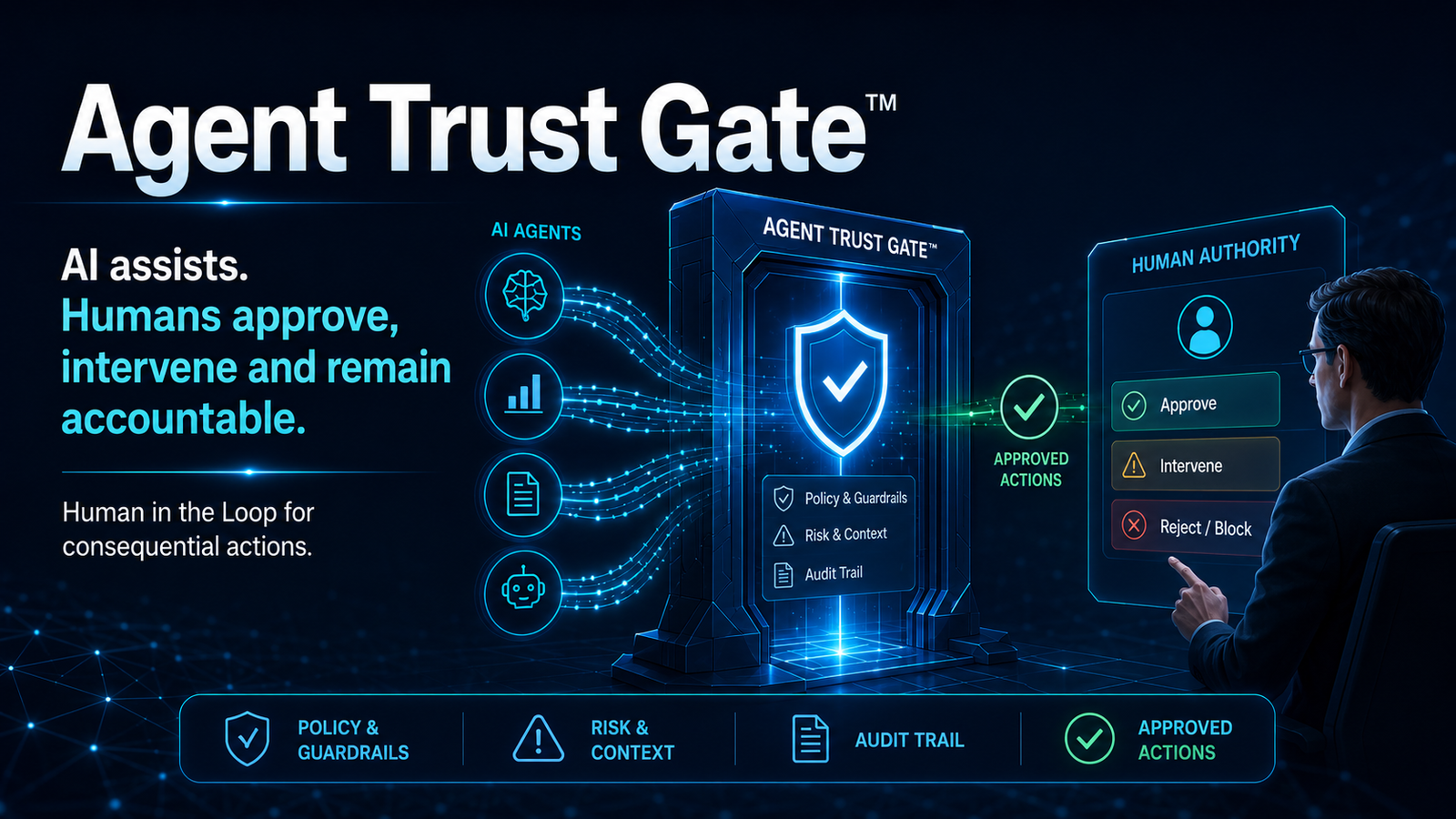
The control question
A forecasting or orchestration system may decide that an action is useful. ATG asks a different question immediately before execution: is this exact agent authorised to perform this exact action now, within its current mandate, limits and evidence?
That distinction matters because an agent can be technically capable of changing a supplier, increasing an order, rerouting a shipment or reallocating inventory without necessarily being authorised to do that particular thing under the organisation's current policy. ATG is designed around that moment between recommendation and consequence.
What a GatePass decision can check
- declared agent standing and accountable principal;
- current mandate, supplier, account, jurisdiction, amount and risk limits;
- evidence required by policy;
- verified human authority where the action crosses a policy threshold;
- exact-action binding, expiry and replay controls;
- separate decision and simulated execution evidence.
Illustrative retail and supply-chain actions
A replenishment agent may remain inside a pre-approved product, supplier, quantity and spend envelope. A substitution may be acceptable only where category, quality, geography and price rules still hold. A shipment reroute may be allowed below a cost or delay threshold but require a human authority proof above it. An inventory transfer may be permitted between approved locations yet refused when the destination, quantity or value changes.
The point is not to slow every action. The point is to make low-risk actions fast while proving authority before higher-consequence actions proceed.
Example risk tiers
Low-risk status updates may be eligible for a fast path. A bounded reroute may pass automatically if it remains inside policy. A large replenishment order or unapproved supplier change may require Verified Human Authority. A forbidden or unverifiable action is refused.
Evidence after the decision
The public model separates the decision from simulated execution evidence so a reviewer can see what was proposed, why it was allowed or refused, which authority and evidence were relied upon, and whether the later action still matched the action that was authorised. That makes the trust boundary reviewable rather than dependent on an agent's own explanation.
What ATG is not
ATG does not replace demand forecasting, warehouse management, logistics optimisation, ERP, procurement systems, payment providers or supply-chain AI. The public implementation is a local deterministic demonstrator and does not execute real external actions, payments or settlements.
Read the exact-action authority control model → Review the evidence path → Open the public repository →
Agent Trust Gate™ — Exact-Action Authority for AI Agents. Local demonstrator only.